Showing posts with label IPV6. Show all posts

Monday, 30 March 2020

IPV6 CHAPTER 5 Types of IPV6 Unicast Addresses

Unicast Address


Used when one host to one host communication is desired.
Example –Unicast address will be used when Host A wants to communicate with Host B.

Global Unicast Address
Unique-Local Address
Link-Local Address

Global Unicast Address

These are equivalent to IPv4’s public address.
These are globally addresses which are unique.
Routable  globally
Assigned by IANA
First 3 bits are always 001 .
Always start with 2 or 3

Unique Local Address(ULA)

These are globally unique IP addresses but used for local communication.
Routable but not in IPV6 Global prefix table.
First 7 bits are always 1111 110.
Always start from FC or FD.

Link Local Address

Auto configured IP address once IPv6 is enable or configured.
These addresses are not routable, so a Router never forwards
Used for communication among IPv6 hosts on a link (within domain)

First 16 bits are set as 1111 1110 1000 0000  & the next 48-bits are set to 0
Always starts with FE80:0000:0000:0000

Thanks for Reading !!!!

Sunday, 29 March 2020

IPV6 CHAPTER 4 IPV6 ADDRESSING MODES

IPV6 Addressing Modes


Unicast 

Multicast

Anycast

Note :- In IPV4 we have  Unicast , Multicast and Broadcast . There is no Broadcast address in IPV6.


Unicast Addressing Mode


Used when one host to one host communication is desired.
Example –Unicast address will be used when Host A wants to communicate with Host B.
                                                                                             
Global Unicast Address
Link-Local Address
Unique-Local Address

Multicast Addressing Mode 


Used when one host to many (a group of hosts) hosts communication is desired.
The multicast information is send on an special multicast address and all the hosts which are in that multicast group receives the information.
Range – FF00::/8
All node on link
Address – FF02::1

Anycast Addressing Mode 


New type of addressing introduced.
It is different from Broadcast.
In this addressing mode, multiple interfaces are assigned with same Anycast IP address.
When a host wishes to communicate with a host equipped with an Anycast IP address, it sends the  message. With the help of complex routing mechanism, that message is delivered to the host closest to the Sender in terms of Routing cost.

Saturday, 28 March 2020

IPV6 CHAPTER 3 - Making IPV6 Address Short


We saw that IPV6 is 128bits and represented in Hexadecimal number system.
Binary Number System Representation
•    0010000000000001 0000000000000000 0000000000000000 0000000000000000 0000011000010100 0000000000000000 0000000000000000 1011110110000000
Hexadecimal Number System Representation
2001:0000:0000:0000:0614:0000:0000:BD8


Making IPV6 address short

2001:0000:0000:0000:0614:0000:0000:BD80
Rule 1 :- Leading Zeros can be discarded.
2001:0:0:0:614:0:0:BD80
Rule 2:- We can once replace consecutive two or more blocks containing zeros by double colon : :
2001::614:0:0:BD80

Thanks for Reading!!!!
                                                                                             

Friday, 27 March 2020

IPV6 CHAPTER 2 - IPV6 ADDRESS FORMAT

Will Focus on :-


  • Hexadecimal Number System
  • Understanding IPV6 Address Structure
  • Splitting IPV6 addresses  
  • IPV6 – CIDR Representation.


Hexadecimal Number System


IPV6 addresses are 128 bits addresses.
IPv6 addresses are written using hexadecimal.
Before learning IPv6 Address Format.
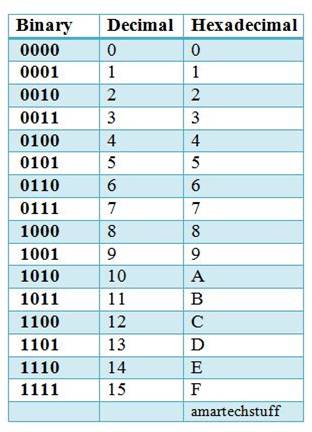
Let’s First Understand Hexadecimal Number System .

HEXADECIMAL NUMBER SYSTEM

IPV6 ADDRESS FORMAT

IPV6 is I28 bits address. 
Divided into 8 blocks . 
Each block having 16 bits .
Each block is represented in 4 digit Hexadecimal number.
Each block is separated by colon 


IPV6 ADDRESS FORMAT

Example :-
0010000000000001 0000000000000000 0000000000000000 0000000000000000 0000011000010100 0000000000000000 0000000000000000 1011110110000000

Splitting IPV6 Addresses

The 128 bits IPV6 address is split into two 64 bits segments the top 64 bits is the network part and the lower 64 bits the host part.
Host part is automatically calculated by the host itself.
eg. 
2001:0000:0000:0000:0614:0000:0000:BD80

CIDR Notation

2001:0000:0000:0000:0614:0000:0000:BD80 /64
64 => Network Prefix Length
Represents the number bits used for Network .

                                                                                              
Thanks for Reading !!!!

Thursday, 26 March 2020

IPV6 CHAPTER 1 - Introduction to IPV6


IPv6 stands for Internet Protocol version 6
IPv6 was developed by the Internet Engineering Task Force (IETF).
New version of IP Protocol which is in use.
IPv6 was also called IPng in the early days of IPv6 protocol development stage.


WHY NOT IPV5 ?

•IPv5 is used for Experimental purposes .
•Known as “Internet Stream Protocol                                                                                             
•Introduction to IPV6
•IPV6 is mainly deployed since already existing IPV4 is running out of addresses .
•IPv4 is 32 bits .
•Provided 2^32 =4294467295 (about 4.3billion) IP addresses.
•For IPV4 Different Techniques were introduced –Subnetting , NAT. But still there will be storage of IP addresses.
                                                                                             

Features of IPV6

•IPV6 is 128 bits.
•Provides 2^128=
340,282,366,920,938,463,463,374,607,431,768,211,456
          340 trillion trillion trillion addresses
•Bigger Address Space as compared to IPV4.
•Using IPV6 we can assign IP address to every possible things.
•NAT not required.
•No Broadcast (Anycast is introduced)
                                                                                             

Features of IPV6

•Header Format is simple as compared to IPV4
•IPv6 contains 6 basic header field whereas IPV4 has 12.
•Faster Processing.
•Inbuilt IPSec (now optional)
Stateless auto configuration - No more need to configure IP addresses for end devices since Device gets IPV6 address by including its own MAC Address.
•Built-in support for QoS tagging.
•Built-in support for IP Mobile (IP address Mobility)                                                                                            
Thanks for Reading !!!!